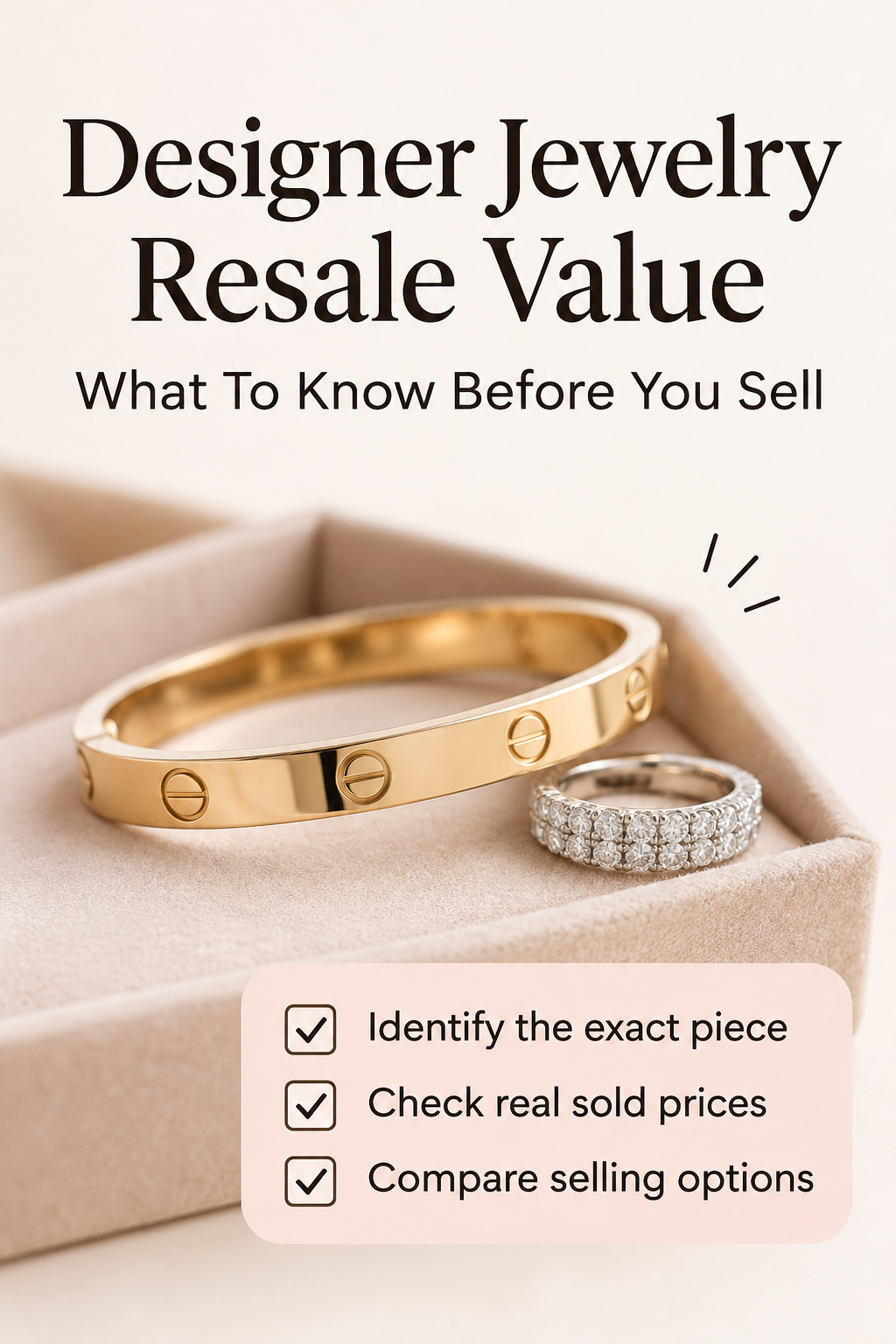

The receipt, the insurance appraisal and the first buyer’s quote for a designer piece can all show different numbers. Each one answers a different question. If you’re thinking about selling, the figure that matters is what you’d receive after fees and expenses.
Whether you bought the piece, inherited it or received it as a gift, a realistic estimate comes from three steps: identifying it accurately, finding closely matched completed sales and checking the terms of each way to sell. That gives you a working range to compare against written offers.
Key Takeaways
- Retail price, insurance value, sold price, purchase offer and net proceeds are five different figures. Only net proceeds tell you what you keep.
- Identify the exact collection, size, metal and condition before you research prices.
- Build your estimate from completed sales of close matches, not asking prices.
- Brand-level resale percentages are useful context, but they can’t price your specific piece.
- Compare selling routes on the money that reaches your account and how long you’ll wait for it.
Know Which Jewelry Value You’re Looking At
Before researching prices, label the figures you already have.
| Figure | What it measures | What it isn’t |
| Original retail price | What the piece cost new | A guide to what a buyer will pay today |
| Insurance replacement value | What it would cost to replace for insurance purposes | An offer to buy |
| Secondary-market sold price | What a comparable used piece sold for | What the seller received after costs |
| Purchase offer | What a specific buyer offers after inspection | A market-wide valuation |
| Net seller proceeds | Sale price minus commission, charges and seller-paid costs | Profit, which also accounts for what you paid |
An insurance appraisal is usually set at replacement cost, which is why it often runs well above any resale offer. Jewelers of America makes the resale principle clear: fair market value has to reflect the item’s current, used condition.
Grading reports are a separate thing again. The Gemological Institute of America (GIA) doesn’t put a dollar value on jewelry. Its lab reports document quality characteristics, which gives a buyer useful evidence without promising a price.
Sentimental value may shape whether you want to sell, but it doesn’t change what a buyer will pay.
Identify the Exact Piece
“Designer bracelet” is too vague for a buyer to price. Collection, size, metal and condition can all move the number. Start with a simple inventory:
- Brand, collection name and any reference or serial number
- Size, including ring size, bracelet or chain length and pendant drop
- Metal type and any stamped marks
- Stones, with approximate size and any lab paperwork
- Condition, noting scratches, worn settings or loose stones
- Alterations such as resizing, replaced clasps or reset stones
- Receipts, repair records, the original box and pouch, and any warranty or grading documents
Metal stamps help, but they only tell part of the story. A “750” mark means 750 parts gold per 1,000, or 75% gold, which is 18-karat. That describes metal content, not resale value, and it doesn’t prove a brand name is genuine.
Treat a stamp, engraved logo or branded box as evidence to investigate, not proof on its own. Even a genuine signature doesn’t guarantee a premium. Sotheby’s notes that a signature can raise a vintage piece’s value, but not always, so a buyer will still weigh the collection, period and condition.
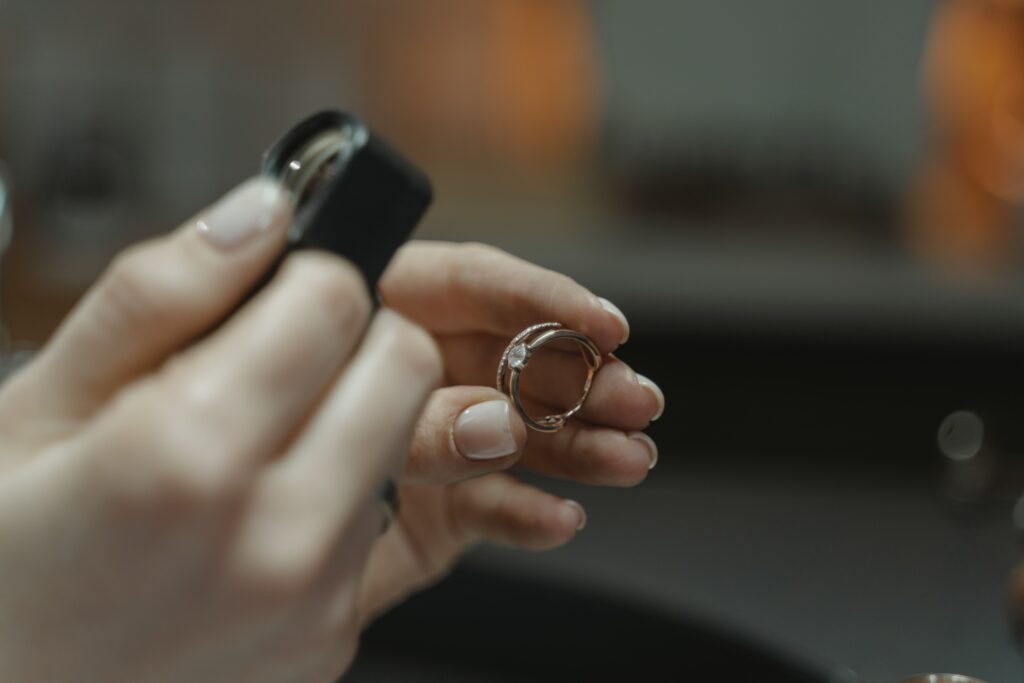
Take clear, well-lit photos of the front, back, clasp, setting and every mark, with a ruler for scale. Specialists can give a first opinion from photos, but treat any photo-based estimate as provisional until the piece is inspected.
Ask before cleaning or altering anything. GIA warns that chlorine bleach can damage gold alloys, and polishing, resizing or taking a piece apart can affect its value.
Build a Realistic Range From Sold Pieces
Once you know exactly what you have, look for completed sales of close matches. Several transactions give you a range; one listing gives you a guess.
For each comparable, check the collection and model, metal and stones, size, condition, accessories such as box and papers, and the sale date, giving more weight to recent sales. Keep asking prices separate from completed sales. On eBay, filtering for sold items shows what buyers actually paid, which is far more useful than live listings.
For auction results, note which price you’re looking at. Sotheby’s defines the hammer price as the winning bid. The buyer’s total bill adds fees on top, and the seller’s proceeds come off after commission. If a source doesn’t say which figure it shows, mark it as uncertain.
A simple worksheet keeps your research honest. For each sale, record the identifying details, sale date, condition, price type (sold price, accepted offer, hammer price or buyer-inclusive total), amount and how closely it matches your piece. If your close matches fall in a similar band, that’s your working estimate. If they vary widely, look for differences in condition, specification or price type before you settle on a range.
Don’t apply automatic percentage deductions for condition or missing paperwork. There’s no reliable formula. If close matches are scarce, consider an independent appraisal, and ask about the appraiser’s professional credentials and valuation experience. A buyer’s free quote helps you judge that buyer’s terms, but it doesn’t tell you what every buyer would pay.
Put Brand-Level Resale Figures in Context
Brand-level resale percentages can set expectations, but always check whose transactions they describe and what the percentage measures.
For one buyer’s data, Suttons & Robertsons’ jewellery resale report analyzes more than 2,000 of the company’s own outright and consignment sales between January 2024 and June 2026. It offers a useful view of patterns within that business rather than a market-wide valuation of any single piece.
Within that analysis, the report puts Tiffany’s resale value at 60% to 80% of original retail. That range describes the report’s findings. It doesn’t guarantee what you’ll be offered, and commission or a buyer’s margin may still come off the eventual sale price.
Be careful when comparing percentages. A retention figure compares the resale price with the original retail price. A commission applies to the later sale price. Because they use different starting amounts, you can’t compare them directly. When you read any report or quote, note whether the figure refers to original retail, a resale price, an offer or net proceeds, and ask if it isn’t clear.
Choose a Selling Route That Fits Your Priorities
With a working range in hand, compare routes on how the price is set, when you get paid and which costs or risks you’re willing to accept.
| Route | Suits | How the price is set | When you’re paid | Main uncertainty |
| Outright sale to a specialist buyer | Sellers who want a firm figure fast | Buyer inspects and makes a final offer | As agreed after you accept | Whether the final offer matches the first estimate |
| Consignment | Sellers who can wait | Agreed with the consignee, with commission deducted | After the piece sells | How long it takes and the final price |
| Auction | Signed, rare or high-value pieces | Bidding sets the hammer price | After the sale settles | It may sell below estimate or not at all |
| Online marketplace | Sellers comfortable listing and shipping | You set the price | Per the platform’s payout terms | Disputes, returns and safe delivery |
| Metal-focused buyer | Broken or unbranded pieces | Metal weight and purity, less margin | As agreed after you accept | Whether brand or design value is ignored |
Weigh timing against uncertainty. An outright sale gives you a known figure once the buyer has inspected the piece and you’ve accepted. Consignment or auction might bring a higher gross price, but timing and outcome are less certain, so check what you’d owe if the piece came back unsold.
Get the terms in writing: inspection conditions, every deduction, payment timing, who insures the piece while someone else holds it, and what happens if it doesn’t sell. Keep a pawn loan separate from a sale comparison, because a loan secured on jewelry has to be repaid with interest.
If you’re clearing out other valuables at the same time, the same disciplined approach to selling what you already own applies: sort by resale value, photograph well and match each item to the right platform.
Compare the Money You’ll Actually Keep
Put every option on the same footing by working out what would reach your account before any tax.
Net proceeds = sale price minus seller commission, applicable charges and seller-paid costs such as shipping and insurance.
For an outright sale, use the written final offer after any disclosed deductions. Don’t subtract a commission the buyer hasn’t charged.
Here’s a hypothetical example. A piece sells on consignment for $2,000 with a 20% commission and $50 in seller-paid shipping and insurance. Commission takes $400, leaving $1,550. Against a separate outright offer of $1,500, the real difference is $50, not $500, and the consignment route also involves waiting and the chance of a lower price or no sale. These figures only illustrate the math. Get written, item-specific terms before you compare real options.
Protect the handover, too. A tracked parcel isn’t necessarily insured for the jewelry’s full value, so check your shipping service’s coverage limits before you post anything. For a piece worth more than the available cover, ask the buyer about insured collection or an in-person appointment.
Conclusion
Selling designer jewelry well comes down to preparation. Know which value you’re looking at, identify the piece precisely and build your range from completed sales of close matches. Use brand-level figures as context rather than a price tag. Then compare every route on the money you’d keep, how long you’d wait and what could go wrong, and get each offer in writing before you hand anything over.
FAQ
Is my insurance appraisal what my jewelry is worth?
No. An insurance appraisal reflects the cost of replacing the piece, which is usually much higher than what a buyer will pay for it used.
Where can I find real sold prices for designer jewelry?
Look for completed sales of close matches, such as eBay sold listings and auction results. Check whether auction figures are hammer prices or include buyer fees.
Is consignment always better than selling outright?
Not always. Consignment can bring a higher sale price, but commission, costs and waiting time can shrink or erase the difference.
Does a gold stamp prove my jewelry is designer?
No. A stamp such as 750 describes metal content. Brand authenticity needs a separate assessment by a specialist.