
Have you ever gotten paid on Friday, only to wonder where all your money went by Tuesday? You’re not alone. Between bills, groceries, gas, and unexpected expenses, it can feel like your paycheck disappears before you even have a chance to enjoy it.
That’s where paycheck budgeting comes in.
Instead of trying to manage your money for an entire month, paycheck budgeting helps you plan your spending one paycheck at a time. It’s a practical way to stay on top of bills, avoid overdrafts, build savings, and stop living paycheck to paycheck.
The best part? You don’t need a fancy budgeting app or complicated spreadsheet to get started. A notebook, calendar, and calculator can work just fine.
Here’s how to budget by paycheck, even if you’re starting with very little money.
What Is Paycheck Budgeting?
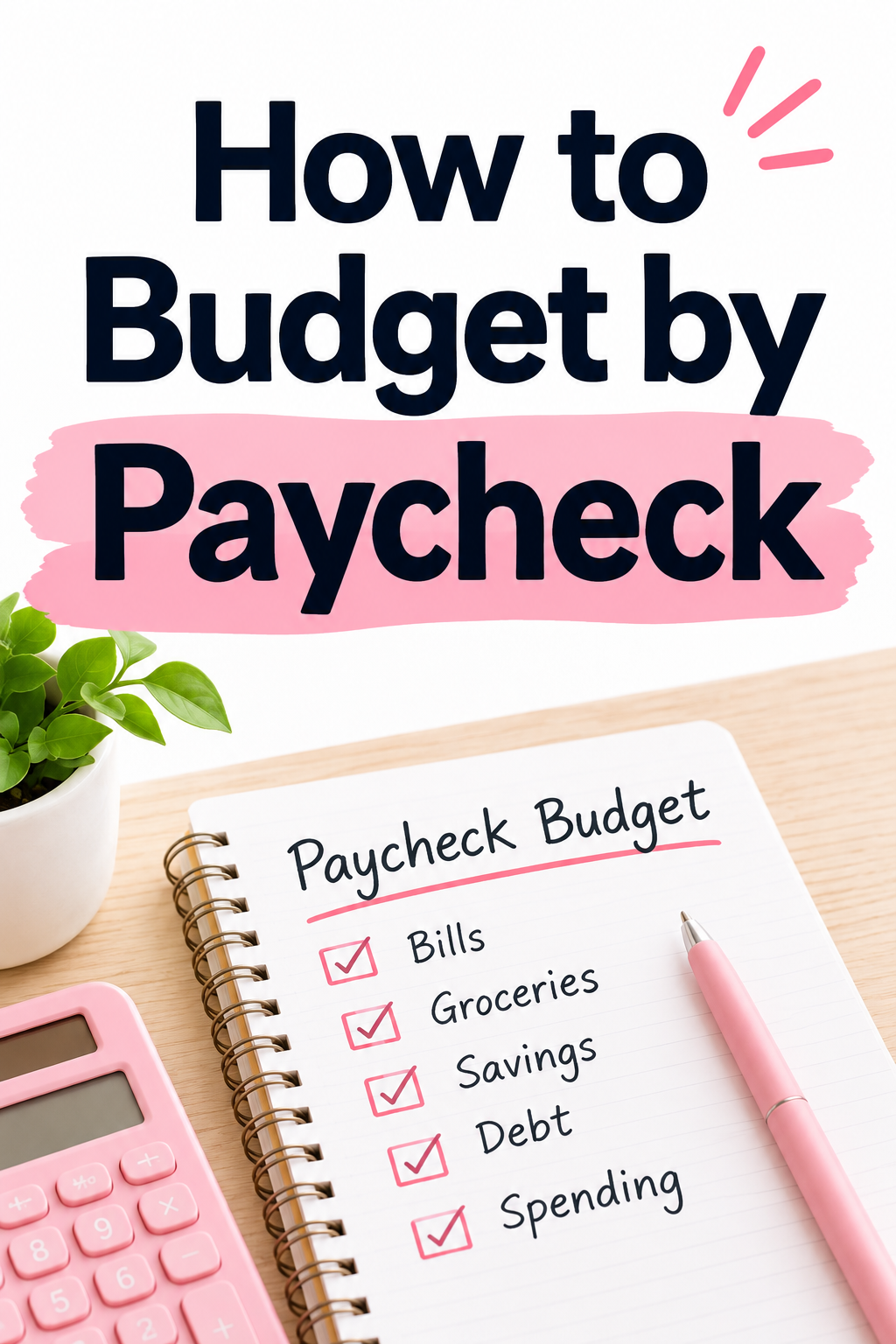
Paycheck budgeting is a money management method where you assign every paycheck a specific purpose before spending it.
Traditional monthly budgets look at how much money you earn and spend throughout an entire month. Paycheck budgeting takes a more detailed approach by focusing on the money available between paydays.
For example, if you get paid every other Friday, you’ll create a separate budget for each paycheck.
Each budget accounts for:
- Bills due before your next paycheck
- Groceries and household essentials
- Gas and transportation
- Debt payments
- Savings goals
- Personal spending
- Upcoming irregular expenses
The goal is simple: Know exactly where your money needs to go before you spend it.
This approach is especially helpful for people who get paid weekly, biweekly, or twice a month.
Why Budgeting by Paycheck Works
One of the biggest problems with traditional monthly budgeting is timing.
You might earn enough money to cover your monthly expenses but still struggle to pay certain bills because they’re due before your next payday.
For example, imagine you receive $1,500 every two weeks.
Your rent is $1,200, your car payment is $350, and your utility bills total $300.
On paper, your income may cover those expenses. But if everything is due during the same week, you could find yourself short on cash.
Paycheck budgeting helps you anticipate these situations.
Benefits of Paycheck Budgeting
1. Prevents overspending. You know how much money is actually available for discretionary purchases.
2. Helps avoid late fees. Planning bills around paydays reduces the chances of missing payments.
3. Makes saving easier. You can set aside a small amount from each paycheck instead of waiting to see what’s left.
4. Reduces financial stress. Knowing your upcoming expenses can make money management feel less overwhelming.
5. Works with different income schedules. Whether you’re paid weekly, biweekly, or semi-monthly, you can customize your budget.
6. Helps break the paycheck-to-paycheck cycle. Over time, you can build a financial cushion that makes future paydays less stressful.
How to Budget by Paycheck in 8 Easy Steps
Step 1: Write Down Your Paydays
Start by looking at your pay schedule.
Do you get paid:
- Every Friday?
- Every other Friday?
- On the 1st and 15th?
- Once a month?
- On an irregular schedule?
Write down your upcoming paydays for the next two or three months.
For example, if you’re paid every other Friday, your schedule might look like this:
| Paycheck | Payday |
|---|---|
| Paycheck #1 | November 6 |
| Paycheck #2 | November 20 |
| Paycheck #3 | December 4 |
| Paycheck #4 | December 18 |
Knowing when money arrives is the foundation of paycheck budgeting.
Money-saving tip: If you’re paid biweekly, you’ll usually receive 26 paychecks per year. That means two months typically include three paychecks instead of two. Those extra-paycheck months can be great opportunities to build savings or pay down debt.
However, remember that a biweekly schedule is different from being paid twice a month, which usually results in 24 paychecks per year.
Step 2: List All Your Monthly Bills
Next, write down every bill you pay, including its amount and due date.
Don’t forget smaller expenses such as streaming services, subscriptions, and automatic payments.
Here’s an example:
| Bill | Amount | Due Date |
|---|---|---|
| Rent | $1,000 | 1st |
| Car Payment | $300 | 10th |
| Electric Bill | $150 | 12th |
| Internet | $70 | 15th |
| Cell Phone | $80 | 20th |
| Car Insurance | $120 | 25th |
| Streaming Services | $30 | 28th |
| Total | $1,750 |
This gives you a clear picture of your fixed monthly expenses.
You should also account for expenses that don’t happen every month, such as car registration, annual subscriptions, holiday shopping, and insurance premiums.
Step 3: Assign Bills to Each Paycheck
Now comes the most important part of paycheck budgeting.
Look at your paydays and determine which bills need to be paid with each paycheck.
For example, suppose you receive $1,500 on November 6 and another $1,500 on November 20.
You might assign expenses like this:
November 6 Paycheck: $1,500
| Expense | Amount |
|---|---|
| Set Aside for Next Rent Payment | $500 |
| Car Payment | $300 |
| Electric Bill | $150 |
| Internet | $70 |
| Groceries | $200 |
| Gas | $75 |
| Savings | $50 |
| Personal Spending | $50 |
| Total Allocated | $1,395 |
| Remaining Cushion | $105 |
November 20 Paycheck: $1,500
| Expense | Amount |
|---|---|
| Set Aside for Next Rent Payment | $500 |
| Cell Phone | $80 |
| Car Insurance | $120 |
| Streaming Services | $30 |
| Groceries | $200 |
| Gas | $75 |
| Savings | $100 |
| Holiday Fund | $100 |
| Personal Spending | $100 |
| Total Allocated | $1,305 |
| Remaining Cushion | $195 |
In this example, you’re saving half your rent from each paycheck rather than trying to cover the entire $1,000 from one.
Important: This example assumes your current rent is already paid and you’re setting aside money for the following month’s rent. If you’re just starting and rent is due before you’ve accumulated enough, you’ll need a transition plan to cover that first payment.
Step 4: Calculate Your Spending Money
After assigning your bills, determine how much money you have available for everyday expenses.
Use this formula:
Paycheck – Bills – Savings – Essential Expenses = Available Spending Money
For example:
$1,500 paycheck – $1,000 bills – $100 savings – $250 essentials = $150 available spending money.
That $150 is what you can safely spend on nonessential purchases until your next paycheck.
This step helps prevent a common budgeting mistake: assuming that because you have money in your bank account, it’s available to spend.
Some of that money may already be reserved for upcoming bills.
Step 5: Create Sinking Funds for Irregular Expenses
One of the smartest ways to budget by paycheck is to create sinking funds.
A sinking fund is money you gradually set aside for a future expense.
Unlike an emergency fund, which covers unexpected situations, sinking funds help you prepare for expenses you know are coming.
Examples include:
- Christmas gifts
- Birthday presents
- Car repairs and maintenance
- Back-to-school shopping
- Property taxes
- Annual insurance premiums
- Vacations
- Medical expenses
Let’s say you want to save $600 for Christmas and have 20 paychecks before you need the money.
You would need to save just $30 per paycheck.
That’s much easier than trying to come up with $600 in December.
You can keep sinking funds in separate savings accounts, designated savings buckets, or even labeled cash envelopes.
Step 6: Build an Emergency Fund
Unexpected expenses are one of the biggest reasons people struggle to stick to a budget.
A flat tire, medical bill, or broken appliance can quickly derail your finances.
That’s why it’s important to include emergency savings in your paycheck budget.
If money is tight, start with a manageable goal.
For example:
- Save your first $100.
- Work toward $500.
- Build a $1,000 emergency cushion.
- Eventually aim for several months of essential living expenses.
Even saving $10 or $20 per paycheck can help.
If you save $20 from each of 26 biweekly paychecks, you’ll accumulate $520 in a year, not including interest.
The key is consistency.
Treat emergency savings like a regular bill that you pay yourself.
Step 7: Track Your Spending Between Paychecks
Creating a budget is only half the process. You also need to monitor your spending.
You can do this with:
- A notebook
- A printable budget planner
- A spreadsheet
- Your bank’s budgeting tools
- A budgeting app
- Cash envelopes
For example, if you budget $200 for groceries over two weeks, keep track of what you spend.
If your first grocery trip costs $125, you have $75 remaining until your next paycheck.
Tracking your purchases helps you identify spending habits and make adjustments before running out of money.
Step 8: Review and Adjust Every Payday
Your first paycheck budget probably won’t be perfect.
You might underestimate grocery expenses, forget a subscription, or encounter an unexpected bill.
That’s normal.
Every payday, take 10 to 15 minutes to review your finances.
Ask yourself:
- Did I stay within my budget?
- Which categories did I overspend in?
- Did I forget any bills?
- Can I increase my savings?
- Are there expenses I can reduce?
- What bills are due before my next payday?
Make adjustments as needed.
The goal isn’t perfection. It’s building a budgeting system that works for your actual life.
How to Budget by Paycheck With Irregular Income
Paycheck budgeting can also work for freelancers, gig workers, commission-based employees, and self-employed individuals.
However, you’ll need to make a few adjustments.
Instead of assuming you’ll earn the same amount every payday, estimate your income conservatively.
For example, if your recent monthly income has ranged from $2,000 to $3,500, you might build your essential spending plan around $2,000.
When you earn more, use the additional money to build a buffer, cover future expenses, or pay down debt.
Consider these strategies:
Prioritize essential bills. Housing, utilities, food, transportation, and other necessities should come first.
Keep a separate account for taxes. If you’re self-employed, remember that income taxes and self-employment taxes may not be withheld automatically.
Build an income buffer. Save money during higher-earning periods to help cover lower-income months.
Review your budget whenever money arrives. You don’t need to wait for a traditional payday.
The Consumer Financial Protection Bureau also offers free tools for tracking income, planning bills, and creating a cash-flow budget.
Paycheck Budgeting vs. Monthly Budgeting
Both methods can help you manage your finances, but they approach money differently.
| Paycheck Budgeting | Monthly Budgeting |
|---|---|
| Plans spending around each payday | Plans spending for the entire month |
| Focuses on bill due dates | Focuses on monthly income and expenses |
| Helpful for managing cash flow | Helpful for seeing the big financial picture |
| Requires updates each payday | Usually reviewed monthly |
| Works well for tight budgets | Works well for predictable income |
You don’t necessarily have to choose one over the other.
In fact, using both methods together can be especially effective.
Create a monthly budget to understand your overall finances, then use paycheck budgeting to decide exactly when and how each expense will be paid.
What If Your Bills Are More Than Your Paycheck?
If your bills exceed your available income, budgeting alone won’t solve the problem.
However, paycheck budgeting can help you identify the shortfall before bills become overdue.
Start by separating essential expenses from optional spending.
Then consider ways to reduce costs.
1. Cancel Unused Subscriptions
Review recurring charges for streaming services, apps, memberships, and other unused subscriptions.
Even eliminating $25 in monthly expenses saves $300 per year.
2. Lower Your Grocery Bill
Meal planning, shopping sales, using coupons, and choosing store brands can help reduce food costs.
Try planning meals around ingredients you already have before heading to the grocery store.
3. Ask About Changing Bill Due Dates
Some utility companies, lenders, and service providers allow customers to change their payment due dates.
Moving a due date closer to payday can make managing cash flow easier.
Always confirm when the new date takes effect and whether it changes your first payment amount.
4. Look for Ways to Earn Extra Money
Consider selling unused items, taking on a side hustle, freelancing, or picking up extra hours at work.
Even an additional $100 per month can help create breathing room.
5. Contact Creditors Before Missing Payments
If you’re struggling to pay a bill, contact the company before the due date.
Ask whether payment arrangements, hardship programs, or due-date changes are available.
Prioritize necessities and avoid taking on expensive new debt just to make your budget appear balanced.
Common Paycheck Budgeting Mistakes to Avoid
Even a simple budgeting system can fail if you overlook certain expenses.
Here are some common mistakes to watch for.
Forgetting Annual Expenses
Car registration, holiday gifts, and annual subscriptions can sneak up on you.
Divide these expenses by the number of paychecks before they’re due and save a little each payday.
Spending Money Reserved for Bills
Just because your checking account shows $500 doesn’t mean you have $500 available for shopping.
Keep track of money that’s already assigned to future expenses.
Not Leaving a Cushion
Try to leave a small amount unallocated in your checking account when possible.
Even a $25 or $50 cushion can help cover minor price differences or prevent an overdraft.
Using Credit Cards to Fill Every Gap
Credit cards can make it tempting to spend beyond your paycheck budget.
If you carry a balance, interest charges can make future budgets even tighter.
Include minimum payments in your budget and develop a realistic repayment plan.
Giving Up After One Bad Paycheck
Some pay periods will be more expensive than others.
If you overspend, review what happened and adjust your next budget.
A budgeting mistake doesn’t mean the entire system has failed.
Free Paycheck Budgeting Template
You don’t need expensive software to create a paycheck budget.
Copy this simple template into a notebook, spreadsheet, or printable planner.
Paycheck Date: __________
Next Payday: __________
Starting Account Balance: $__________
Paycheck Amount: $__________
Total Available: $__________
| Category | Budgeted Amount | Actual Amount |
|---|---|---|
| Rent/Mortgage | $ | $ |
| Utilities | $ | $ |
| Transportation | $ | $ |
| Groceries | $ | $ |
| Insurance | $ | $ |
| Debt Payments | $ | $ |
| Emergency Savings | $ | $ |
| Sinking Funds | $ | $ |
| Personal Spending | $ | $ |
| Other Expenses | $ | $ |
| Total Expenses | $ | $ |
| Remaining Balance | $ | $ |
Remember to include money you’ve already reserved for bills and subtract any pending transactions when determining what is truly available to spend.
You can also download a free budget worksheet from Consumer.gov.
Frequently Asked Questions About Paycheck Budgeting
Is paycheck budgeting good for beginners?
Yes! Paycheck budgeting is one of the easiest budgeting methods for beginners because it focuses on the money you currently have rather than trying to predict an entire month’s spending.
How do I budget if I get paid every week?
Create a new budget every payday. Assign bills, groceries, gas, savings, and other expenses to each weekly paycheck.
For large monthly bills, consider setting aside a portion from multiple paychecks so the full amount is available when due.
How do I budget if I get paid twice a month?
List your two paydays and assign expenses based on when bills are due. You can also split larger expenses, such as rent, between both paychecks if you’ve built enough of a buffer to pay them on time.
What is the best app for paycheck budgeting?
The best option is one that lets you track paydays, bill due dates, and spending categories.
Some people prefer budgeting apps, while others find spreadsheets or paper planners easier to maintain.
You don’t need to pay for an app to make paycheck budgeting work.
How much should I save from each paycheck?
Save what you can realistically afford after covering essential expenses.
A percentage-based goal can be helpful, but even small, consistent contributions matter.
If you’re currently struggling to cover necessities, focus first on stabilizing your cash flow.
Can paycheck budgeting help me stop living paycheck to paycheck?
It can help by showing you where your money goes, reducing surprise expenses, and encouraging consistent savings.
However, if your income is consistently lower than your essential expenses, you may also need to reduce costs, increase income, or seek financial assistance.
Final Thoughts: Take Control of Your Money One Paycheck at a Time
Learning how to budget by paycheck can make a big difference in how you manage your money.
Instead of wondering whether you’ll have enough cash to make it until payday, you’ll have a clear plan for bills, groceries, savings, and everyday spending.
You don’t need to make a lot of money to start budgeting, and you don’t need a complicated system.
Start with your next paycheck.
Write down how much you’re receiving, list the bills and expenses you need to cover, and give every dollar a purpose.
As you continue, work toward building a small financial cushion so you’re not constantly waiting for the next payday to catch up.
Remember: The goal of paycheck budgeting isn’t just to make your money last until your next paycheck. It’s to gradually build enough financial stability that payday stops feeling like a financial rescue mission.