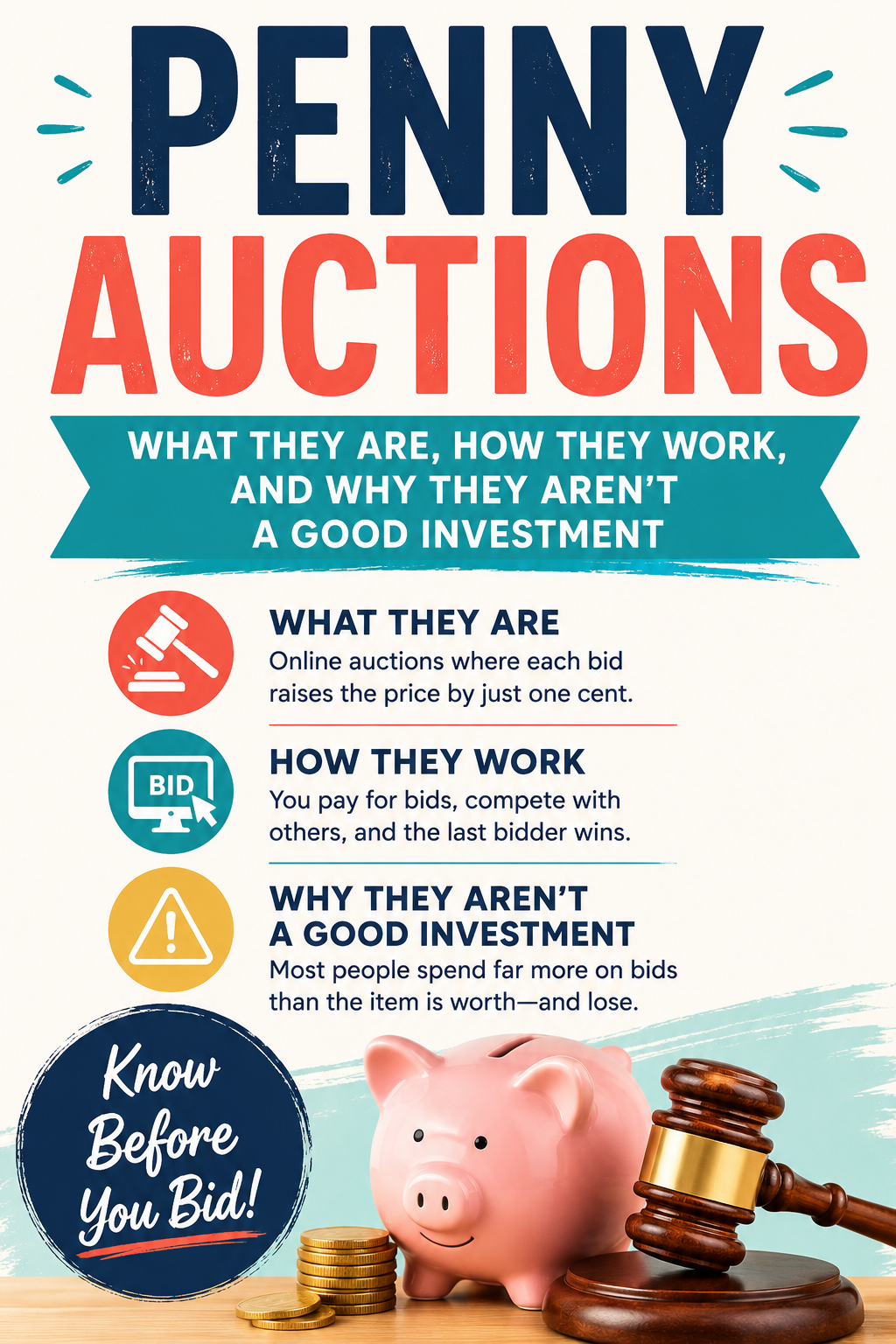


At first glance, penny auctions can look like a treasure chest with the lid cracked open. A brand-new iPhone for $18? A gaming console for $11? Luxury watches selling for pocket change? The numbers flash across the screen like a Vegas slot machine wearing a business suit.
But penny auctions are rarely the bargain they appear to be.
If you’ve ever stumbled across one of these sites and wondered whether they’re legit, here’s what you need to know before spending money on bids.
What Is A Penny Auction?
A penny auction is a type of online auction where users purchase bids in advance and use those bids to compete for products.
Each bid typically raises the item price by one cent and extends the countdown clock by a few seconds. That’s where the “penny” part comes from.
For example:
- An auction starts at $0
- Each bid raises the price by $0.01
- Every time someone bids, the timer resets slightly
- The last person to bid before the clock runs out wins the item
Sounds harmless enough. But here’s the catch:
You usually have to pay for every bid you place, whether you win or lose.
That’s the part many people miss.
How Penny Auctions Actually Work
Let’s say a site charges $1 per bid.
You’re bidding on a laptop that eventually “sells” for $42.
At face value, it looks like someone got a $1,000 laptop for almost nothing. But that final price hides what everyone collectively spent on bids.
Since each bid raised the price by one cent, it took 4,200 bids to reach $42.
If bids cost $1 each, users spent:
4200×1=42004200 \times 1 = 4200
That means the auction site may have made over $4,200 on a laptop worth a fraction of that amount.
The winner still has to pay the final auction price too.
So the “winner” might pay:
- Hundreds of dollars in bids
- Plus the final purchase price
- Plus shipping and fees
Meanwhile, everyone else who lost the auction also lost the money they spent on bids.
It’s less like eBay and more like a carnival game wrapped in countdown timers and adrenaline.
Why Penny Auctions Feel Addictive
Penny auctions are engineered to keep people clicking.
Several psychological tricks are built into the system:
The Sunk Cost Trap
Once someone spends money on bids, they often feel pressured to keep going so the earlier money “wasn’t wasted.”
That mindset can spiral fast.
Countdown Pressure
Timers constantly resetting creates urgency. It feels like the auction is always “almost over,” which pushes people to make emotional decisions instead of rational ones.
Tiny Price Increases
Seeing an item at $7.43 or $19.11 creates the illusion of a huge bargain, even when participants may have already spent hundreds on bids.
Competitive Energy
People stop thinking about value and start focusing on winning.
The auction becomes a digital tug-of-war where pride quietly empties wallets.
Are Penny Auctions Legit?
Some penny auction websites are technically legal businesses. But legal does not automatically mean smart or consumer-friendly.
There have been concerns over the years involving:
- Fake bidders or “bot” activity
- Misleading advertising
- Hidden fees
- Difficulty withdrawing winnings
- Poor customer support
- Inflated retail values
Even when a site operates fairly, the structure itself heavily favors the company running the auction.
The house usually wins.
Why Penny Auctions Are Usually A Bad Investment
Penny auctions are often marketed as a way to save money, but they function much more like gambling than investing.
Here’s why they’re usually a poor financial move.
Most People Lose Money
Only one person wins the auction.
Everyone else loses the money they spent on bids.
Unlike traditional auctions, your bids are not refundable.
The “Deals” Are Misleading
A product may appear to sell for an unbelievably low amount, but the real cost includes all the bids spent during the auction.
The flashy final number is only part of the story.
Emotional Spending Adds Up Quickly
People often spend more chasing an item than they would have spent simply buying it at retail.
It’s easy to lose track when bids feel small individually.
Ten bids here. Twenty there. Another reload of credits. Suddenly your “cheap deal” costs more than Amazon.
There’s No Guaranteed Return
An investment should ideally create value or generate future income.
Penny auctions do neither for most users.
You are spending money on a chance to win, not building an asset.
Better Alternatives To Penny Auctions
If your goal is saving money, there are safer and more predictable options:
- Clearance sales
- Cashback apps
- Coupon stacking
- Refurbished electronics
- Liquidation stores
- Open-box deals
- Facebook Marketplace
- Local auctions with transparent pricing
Those methods may not deliver the same adrenaline rush, but your bank account will probably sleep better at night.
Final Thoughts
Penny auctions thrive on excitement, urgency, and the dream of beating the system.
Occasionally someone does walk away with a good deal. But for most users, the math quietly works against them from the beginning.
What looks like a $20 laptop is often a much more expensive lesson hidden behind flashing countdown clocks and tiny bid increments.
If you enjoy the entertainment factor and treat it like gambling money, that’s one thing. But as a strategy for saving money or making an investment, penny auctions are usually a losing game dressed up as a bargain hunt.