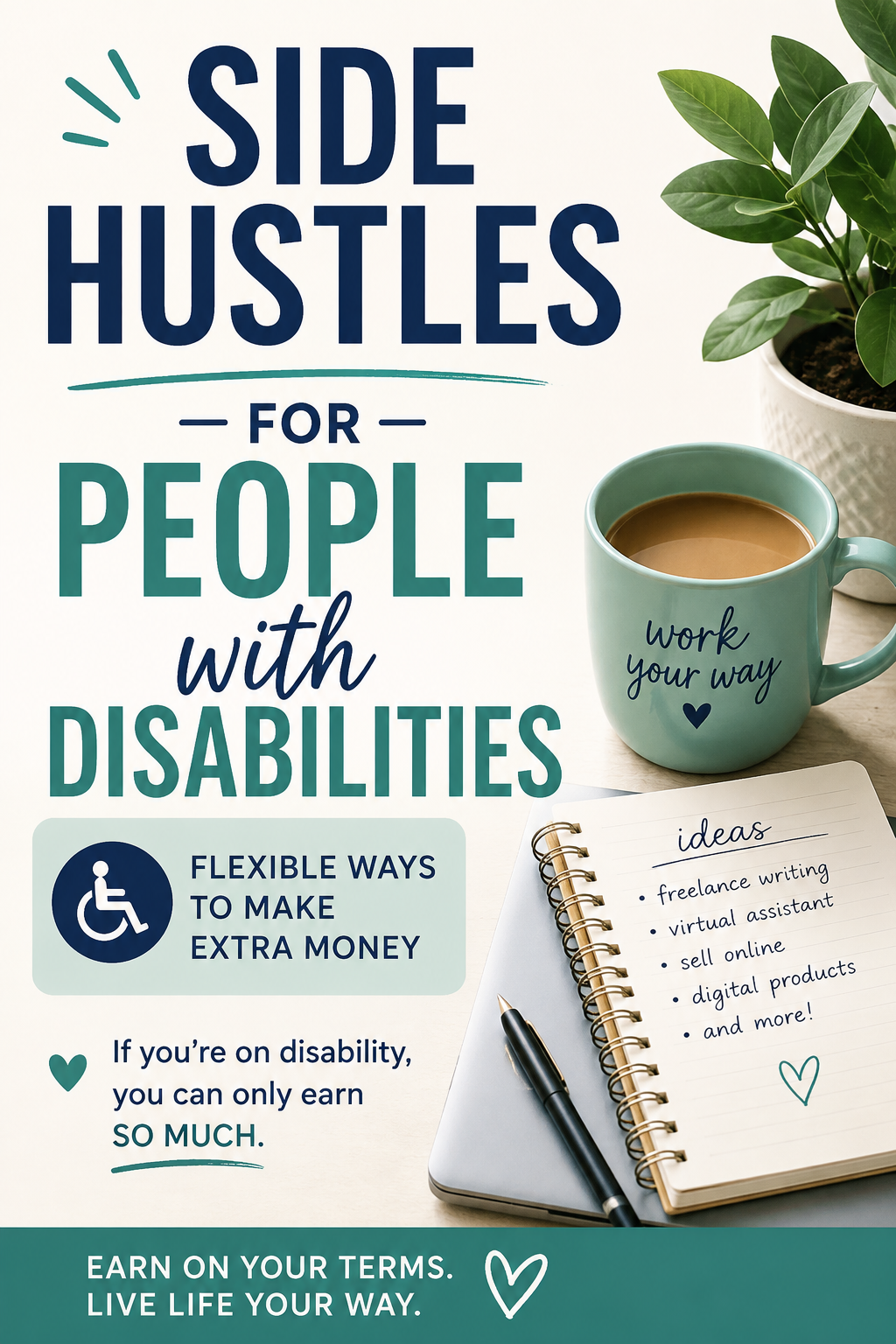


Living with a disability can make a traditional 9-to-5 job difficult, but that doesn’t necessarily mean earning extra money is off the table. A side hustle can offer something a conventional job often can’t: flexibility.
Depending on your abilities and circumstances, you may be able to work from home, choose your own hours, take breaks when needed, or work only on days when you’re feeling up to it.
There is one important consideration, though. If you receive Social Security disability benefits, earning additional income can affect your benefits. Before starting a side hustle, it’s important to understand the rules that apply to you.
Here are some side hustles for people with disabilities, along with what you should know about earning money while receiving disability benefits.
Can You Have a Side Hustle While on Disability?
Yes, in many cases you can work or run a small side business while receiving disability benefits. However, how much you can earn and how those earnings affect your benefits depends on which benefits you receive and your individual circumstances.
The disability income rules for Social Security Disability Insurance (SSDI) and Supplemental Security Income (SSI) are different.
SSDI and Side Hustle Income
For 2026, Social Security considers $1,690 per month to be the Substantial Gainful Activity (SGA) amount for most people with disabilities. For people who are blind under Social Security’s rules, the 2026 SGA amount is $2,830 per month.
But this does not mean that everyone receiving SSDI simply has a $1,690 monthly earnings limit.
SSDI has special work incentives, including a Trial Work Period. In 2026, a month generally counts toward your Trial Work Period when you earn more than $1,210 before taxes. The Trial Work Period allows SSDI recipients to test their ability to work for nine months while continuing to receive their full SSDI payment, regardless of how much they earn, provided they continue to meet Social Security’s disability rules and report their work.
After the Trial Work Period, different rules apply, including a 36-month Extended Period of Eligibility. That’s when the SGA amount can become particularly important.
Self-employment can be more complicated because Social Security may consider factors beyond your income. For example, during an SSDI Trial Work Period, working more than 80 hours in self-employment during a month can cause that month to count as a Trial Work Period service month.
SSI and Side Hustle Income
SSI works differently. There isn’t a simple monthly earnings ceiling where earning one extra dollar suddenly eliminates your benefit.
Generally, Social Security doesn’t count the first $65 of earned income and then excludes half of the remaining earned income when calculating SSI. In practical terms, an SSI payment is generally reduced by about $1 for every $2 you earn from work after applicable exclusions. Other exclusions and work incentives may also apply.
Because the rules can get complicated quickly, especially with self-employment, always report your work and earnings to Social Security and verify how a side hustle could affect your specific benefits before relying on a particular earnings amount. The limits also change periodically.
With that important fine print covered, let’s look at some flexible ways to make money.
1. Freelance Writing
If writing is something you enjoy, freelance writing can be done almost entirely from home and usually on your own schedule.
Businesses need writers for blog posts, newsletters, website copy, product descriptions, social media content and more. You can find clients through freelance platforms or reach out directly to websites and businesses in industries you know well.
One advantage is that you’re often paid by the project rather than by the hour, giving you more control over your workload.
2. Virtual Assistant
Virtual assistants help businesses remotely with tasks such as email, scheduling, data entry, customer service, research and social media.
You don’t necessarily have to commit to full-time hours. Some small business owners only need an assistant for a few hours each week.
If your disability makes commuting or standing for long periods difficult, a remote administrative side hustle may be a much better fit than a traditional second job.
3. Sell Items Online
Selling online can be especially flexible because you control how much inventory you list and when you work.
You might sell:
- Clothing and shoes
- Books
- Collectibles
- Toys
- Electronics
- Vintage items
- Home decor
- Items you no longer need
Platforms such as eBay, Poshmark and Facebook Marketplace make it possible to start with items you already own rather than spending a lot of money on inventory.
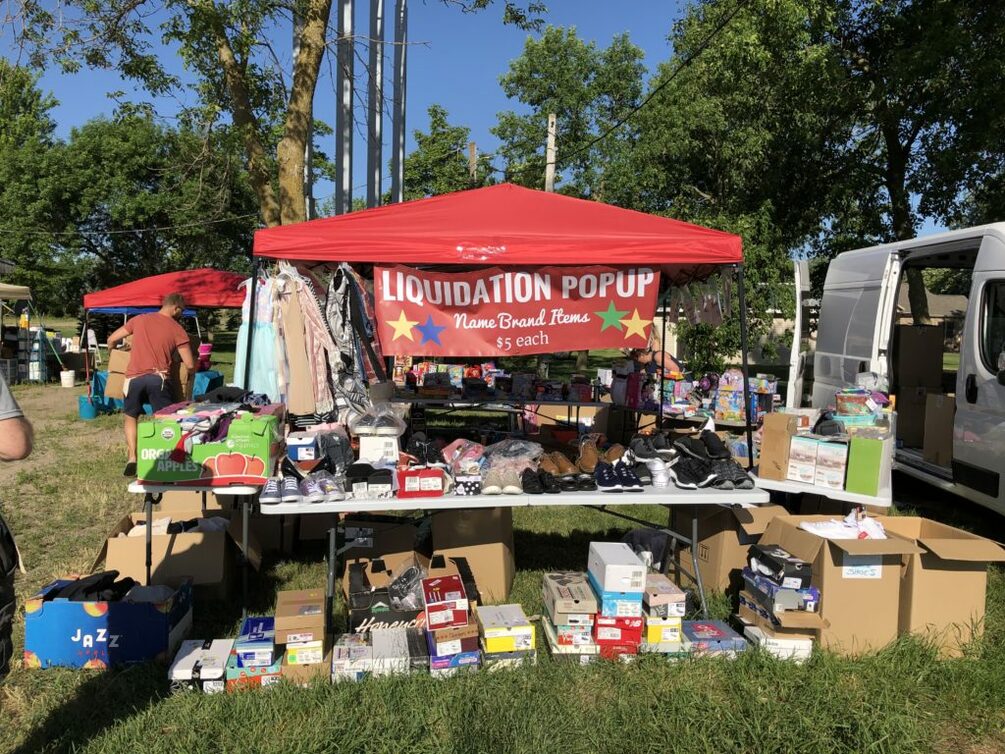
Once you’ve learned what sells, you could expand into thrift-store flipping, retail arbitrage or liquidation merchandise.
4. Create Digital Products
Digital products can be a good option because you create something once and potentially sell it repeatedly.
Examples include printable planners, budgeting worksheets, checklists, invitations, templates, coloring pages, spreadsheets and digital artwork.
You can sell digital downloads through marketplaces such as Etsy or through your own website.
There is usually more work involved upfront, but once a product is created, fulfilling another order may require little or no physical effort.
5. Online Tutoring
If you’re particularly knowledgeable about math, English, science, music or another subject, consider tutoring students online.
You could also tutor adults in subjects such as computer skills, English as a second language, accounting or professional skills.
Online tutoring allows you to schedule sessions around your availability without needing to travel to students’ homes.
6. Pet Sitting
Pet sitting won’t be appropriate for every disability, but it can be a great fit for some people who love pets.
For example, someone who has difficulty working a conventional schedule but is comfortable caring for animals might offer drop-in pet visits or pet sitting from home.
Dog walking is another possibility for people whose disabilities don’t limit walking or physical activity.
The key is choosing services that comfortably fit your own abilities rather than forcing yourself into a hustle that doesn’t.
7. Take Online Surveys and Participate in Research Studies
Online surveys probably won’t replace a paycheck, but they can provide a little extra spending money.
Online research studies, focus groups and consumer panels may pay considerably more than typical survey sites. Universities, market research companies and product-testing companies regularly need participants.
This type of work can be particularly useful if you need something with virtually no schedule commitment.
8. Start a Blog
Blogging is definitely a long game, but it can eventually generate income through advertising, affiliate marketing, sponsored content and digital products.
Choose a subject you know well or genuinely enjoy talking about.
You also don’t have to write about disability unless you want to. Your blog could cover cooking, gardening, crafts, personal finance, gaming, parenting, travel, collectibles or practically any niche with an audience.
9. Affiliate Marketing
You don’t have to create your own products to make money online.
With affiliate marketing, you recommend another company’s products or services and potentially earn a commission when someone purchases through your referral link.
Affiliate links can be shared through a blog, niche website, newsletter, YouTube channel or social media, depending on the program’s rules.
It can take time to build an audience, but affiliate marketing offers considerable scheduling flexibility.
10. Sell Handmade Items
If you enjoy crafting, consider turning your hobby into a small business.
Possible products include jewelry, artwork, greeting cards, crochet items, candles, woodworking projects, personalized gifts and seasonal decorations.
You can sell locally at craft fairs and vendor events or online through marketplaces.
Just remember to calculate your materials and time before setting prices. A craft that costs $8 to make and takes three hours shouldn’t automatically become a $10 product.
11. Proofreading and Editing
Are you the person who immediately spots a typo on a restaurant menu?
Proofreading could put that eagle eye to work.
Authors, bloggers, businesses and students may hire proofreaders or editors to review their work. Most assignments can be completed remotely, and freelance work can often be scheduled around your needs.
12. Social Media Management
Small businesses know they should be posting on social media, but many don’t have the time to do it consistently.
You could help create posts, respond to comments, schedule content or make simple graphics.
Even managing one or two local businesses’ accounts could provide extra monthly income without requiring full-time hours.
13. Sell Stock Photos
If photography is one of your hobbies, consider licensing your photos through stock photography websites.
Landscapes, food, workplaces, household objects, backgrounds and lifestyle images can all have commercial value.
Stock photography isn’t typically fast money, but a growing portfolio can potentially generate sales repeatedly.
14. Offer Local Services
Not every side hustle has to happen online.
Depending on your abilities, you could offer services such as house sitting, plant watering, bookkeeping, tax preparation, sewing and alterations, computer help, organizing or gift wrapping.
Think about tasks other people dislike doing that you can comfortably perform. Sometimes the best side hustle is hiding in plain sight.
15. Become a Content Creator
YouTube, TikTok, Instagram and other platforms have created entirely new ways to build small businesses.
Creators can eventually make money through advertising, affiliate links, sponsorships, subscriptions and product sales.
You don’t need millions of followers, either. A smaller audience centered around a specific niche can sometimes be more valuable than a huge general audience.
Content creation is especially flexible because videos and posts can often be created in batches on days when you have more time or energy.
16. Print-on-Demand
Print-on-demand allows you to sell products featuring your designs without keeping piles of inventory at home.
Depending on the service, your designs can be printed on shirts, mugs, tote bags, posters and other merchandise after a customer orders.
The print-on-demand company handles production and shipping, while you concentrate on designs and marketing.
17. Bookkeeping
If you’re comfortable working with numbers, bookkeeping can become a valuable home-based service.
Small businesses frequently need help recording expenses, reconciling accounts and keeping their financial records organized.
You can potentially work with several small clients instead of relying on a single employer, giving you greater control over your workload.
18. Rent Out Things You Already Own
Sometimes making extra money doesn’t require doing more work at all.
Depending on what you own, you might be able to rent out tools, photography equipment, party supplies, storage space, a parking spot, recreational equipment or other items that spend most of their lives collecting dust.
Rental income may be treated differently from earned income depending on the circumstances, so people receiving SSI or SSDI should still determine how the income needs to be reported.
Finding a Side Hustle That Works With Your Disability
There isn’t one “best” side hustle for people with disabilities because disabilities and individual circumstances vary enormously.
Instead of asking which hustle has the highest earning potential, consider which one gives you the right combination of income, flexibility and sustainability.
Ask yourself:
- Can I do this from home if necessary?
- Can I choose my own hours?
- Can I stop or take a break when needed?
- Does it require physical activity I’m comfortable doing?
- Are there deadlines that could be difficult for me to meet?
- Can I limit my workload during difficult weeks?
- How will the income affect any benefits I receive?
A side hustle shouldn’t leave you feeling trapped by another inflexible work schedule.
Don’t Forget to Report Your Earnings
If you’re receiving SSDI or SSI, don’t assume that small amounts of side-hustle income don’t need to be reported.
Social Security specifically states that people receiving disability benefits must report their work activity.
This is particularly important for self-employment because the rules can be more complicated than simply looking at the amount deposited into your bank account.
Keep good records of your income, business expenses, hours worked and receipts. You may also want to talk with Social Security or a qualified benefits counselor before starting a business or significantly increasing your workload.
Social Security’s Working While Disabled information is a good place to review the current rules.
Final Thoughts
A disability may change what kind of work makes sense for you, but today’s gig economy and online marketplace offer more flexible ways to earn money than ever before.
Whether it’s selling unwanted items online, freelancing a few hours a week, creating digital products or building a small online business, the goal doesn’t have to be replacing a full-time salary. Even a modest amount of extra income can help with groceries, bills, savings or the occasional splurge.
If you receive disability benefits, just make understanding the income rules part of your side-hustle plan from day one. Earning extra money can be worthwhile, but you don’t want a successful side hustle to unexpectedly disrupt benefits you depend on.